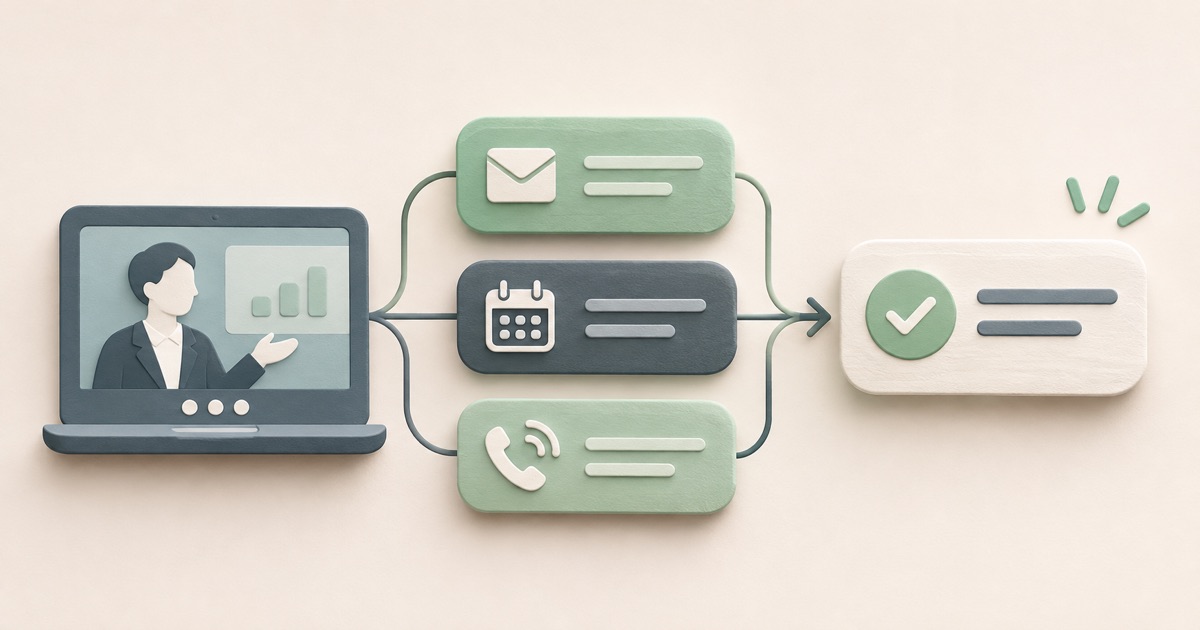
A useful webinar follow-up email delivers what you promised and responds to what the person actually asked. Start with the recording or answer they need. Offer a conversation when there is a reason for one, and check who already owns that relationship before creating another sales task.
For a consulting firm, this means separating three things: participation in an educational event, a question about the method and a request to discuss a business situation. All deserve attention, but they do not justify the same message. Below, a worked example turns six fictional registration records into a small, reviewable follow-up queue. You can download the completed worksheet and replace its invented data with your own verified information.
Decide what you owe the participant
Before writing, list the promises made in the invitation and during the session. Perhaps you offered a recording, a blank worksheet and a written answer to a question that needed checking. Those are distinct deliverables. A calendar link does not answer the question or replace a resource you promised to send.
Read the original wording. “Can you explain how this works with two department heads?” asks for an explanation. “Could we discuss how to apply this in our firm?” requests a conversation. A poll about the participant's role gives context; it does not tell you that the person wants to buy a service. Keep those differences visible in the record that the next colleague will read.
In Cvent's conversation with Sarah Jordan Usher of Mastercam, around the 11-minute mark, she describes sharing attendee information, questions, chat and audience segments with the revenue team. The useful lesson for a service firm is to pass on the context behind a name. This is a practitioner's account from a software company, not evidence that attendees have become qualified opportunities.
Give each promise an owner. The presenter checks a technical answer; the event coordinator checks that the replay works; the relationship owner handles a requested conversation. One person can hold several roles in a small firm. The distinction still matters: a delayed answer should remain visible even after the general replay email has gone out.
Reconcile registrations, connections and questions
Build a participant record from the information you actually have. Keep the event identifier, date, participant identity, source reference and exact question or request. Preserve the source exports separately with appropriate access. The working sheet should contain enough context to act, rather than copying every chat message into a widely shared file.
Check what each export means before joining it to another. A reconnect may produce another row. Two people may share a company domain or a display name. A missing attendance row may mean no observed live connection; it does not establish why the person missed the event or whether they later watched a recording. When identity is uncertain, hold the personal follow-up until it is resolved.
A workflow demonstration by blankarray, published on 20 October 2026, brings together registrations, attendance, poll answers, questions and CRM contacts before creating follow-up tasks. It illustrates one implementation. Its generated buyer labels do not validate purchase intent. Our worksheet instead keeps observed participation and expressed requests separate for human review.
Use a stable person identifier when your records support one, alongside the event identifier. Keep separate people separate even when they work at the same firm. For repeat events, inspect the existing conversation before opening a new task. A new attendance record can add context to an existing relationship without starting another sequence.
Walk through six fictional participant records
Imagine a consulting firm presenting “Prepare a scoping decision before the first workshop” on 17 November 2026. The team reviews the records on 18 November, using Europe/Paris dates. The firm, people, session, source references, requests and permission checks in this example are all invented. No Kmino client outcome is reported.
The registration list contains six people, P01 to P06. The connection export contains six rows: two for P01, two for P02, one for P03 and one for P04. After checking identities, that means four observed live participants. P05 and P06 have no observed live connection. The six connection rows are not six different attendees.
| Person | Information available at review | Decision on 18 November |
|---|---|---|
| P01 | Two connections; explicitly asks to discuss a scoping situation | Relationship owner confirms the requested conversation |
| P02 | Two connections; unanswered question about conflicting objectives | Presenter sends a bounded answer |
| P03 | One connection; existing conversation with Clara after an earlier event | Clara reviews the new context; no parallel email |
| P04 | One connection; no question or contact request | Coordinator sends the promised replay only |
| P05 | No observed connection; requested the replay when registering | Coordinator sends the requested replay without claiming attendance |
| P06 | No observed connection; asks for no further email on 18 November | Suppress follow-up; no replay or sales email in this example |
Scroll horizontally to read all columns if needed.
There are four proposed sends today: P01, P02, P04 and P05. P03 needs an internal check by the existing owner, and P06 is excluded. There is one explicit request for a conversation. There are no accepted sales opportunities in these records. These are classifications of invented data, not attendance or conversion benchmarks.
For this exercise, the team has checked that the four proposed messages are appropriate under the applicable rules and the information given at collection. That is an assumption within the fictional case, not a permission created by the worksheet. P06's later instruction overrides the earlier replay request. Recheck new replies and exclusions immediately before sending.
Choose the message from the request
Use the following bodies as examples, with a real sender identity and the information and opt-out mechanism your message requires. They are not complete campaigns ready to import. If you send commercial email in the United States, the FTC's CAN-SPAM guide covers B2B messages too, including accurate identification, a valid postal address and a way to opt out. Check the rules for each market and the purpose of the actual message.
P04 and P05: deliver the promised recording
Subject: Scoping workshop recording and blank worksheet
Hello,
Here is the recording we promised: [recording link]. The blank scoping worksheet is here: [worksheet link]. The section on identifying a decision owner starts at 12:40. You can use the worksheet to write down the decision and the person responsible before inviting the group.
Best, [Real sender]
The links and chapter time are placeholders in this fictional example. Verify them against your recording, including access from outside your organization. The same body can serve P04 and P05 because it does not claim that either attended or watched a specific part. An invitation to reply can be useful, but the recipient should not have to book a call to obtain what was promised.
P02: answer the question that stayed open
Subject: Your question about conflicting workshop objectives
Hello,
You asked what to do when two department heads expect different decisions from the same workshop. Our proposed starting point is to write each expected decision separately, then ask who has authority to choose the scope. If that authority is unresolved, we would clarify it before sending the group invitation. The worksheet helps describe the disagreement; it does not resolve it for you.
Best, [Real sender]
This answers the invented question without turning it into a claim about P02's company. If the speaker needs more context, ask for the smallest missing detail and state what remains uncertain. When an answer will take longer, acknowledge the question and give a realistic date rather than sending a confident improvisation. Close the task when the promised answer is delivered; reopen it if the person asks something new.
P01: confirm the conversation they requested
Subject: Discussing your scoping situation
Hello,
You asked to discuss how to prepare the first workshop in your situation. I suggest we first clarify the decision to be made and who can approve its scope. Would [time option A] or [time option B] work for you? If you had a different question in mind, we can adjust the purpose before booking.
Best, [Real sender]
The request supports proposing a conversation, not assuming a budget, deadline or buying committee. Record a reply confirming an appointment separately from the original request. If no time is confirmed, keep the status as “conversation requested, scheduling unresolved.” Do not count a calendar link sent as a meeting held.
Keep one owner across repeated events
P03 has already discussed this topic with Clara. The new attendance record belongs in that context. Clara checks whether the session answers an open question, whether a resource is still owed and whether a new message would add anything. The event coordinator should not independently launch a generic sequence while Clara is replying.
In the same Mastercam interview, at 13:31, Usher warns against contacting repeat participants every time they attend. For a service firm, we turn that observation into an ownership rule: review the person's existing exchanges before adding another outreach task. The episode does not establish a universal contact interval.
Company context can help the owner coordinate, but one colleague's request is not another colleague's request. Do not copy private questions to everyone from the same organization. Where several people ask for a joint discussion, confirm who should attend and what may be shared. Otherwise, preserve each person's context and permissions.
Use the worksheet as a decision record
The CSV example has six rows and seventeen columns. It records the review date, event, participant identifier, observed live presence, connection-row count, request, source reference, previous exchange, contact check, decision, owner, next action date, completion condition and status. It also states that the data is fictional and identifies the time zone.
Replace the invented source references with references your authorized colleagues can retrieve. Keep a participant-level row for the decision, even if several connection records support it. Do not automatically add overlapping connection durations: that could count the same minutes twice. No duration calculation is needed for this example's decisions.
Use the completion condition to distinguish “email sent” from “work finished.” For P02, the answer must address the actual question. For P01, confirmation of a time ends scheduling, not sales qualification. For P03, Clara records whether there is an outstanding promise or no further action. For P06, the exclusion must be reflected in the relevant sending systems.
The dates in this exercise organize work on one review day. They are not an optimal cadence. Agree a review point based on the request and your ability to fulfill it. If nothing new has happened after a promised resource was delivered, leave the record closed rather than manufacturing another reason to contact the person.
Review the event without inflating its results
Keep the denominators visible: six registered people, four observed live participants after reconciliation, four proposed sends, one internal review and one exclusion. The one conversation request is a different measure from a confirmed appointment, a held meeting or an accepted opportunity. Each later status needs its own evidence and date.
At the next team review, ask whether the replay was accessible, whether open questions were answered and whether two colleagues contacted the same person. Investigate missing identities and promises left without owners. If a conversation later becomes a client engagement, preserve its other known touchpoints; the webinar's presence in the history alone does not prove it caused the sale.
If the event itself needs work, start with planning a B2B webinar. If you need public material from the recording, use the separate webinar repurposing guide. Participant follow-up concerns what you owe a person; content repurposing concerns what can be published for an audience.
Kmino helps service firms connect useful expertise, webinars and business conversations. If the missing piece is a clear promise, a usable resource or ownership after the session, review our offers in French and identify the part of the work that needs support.