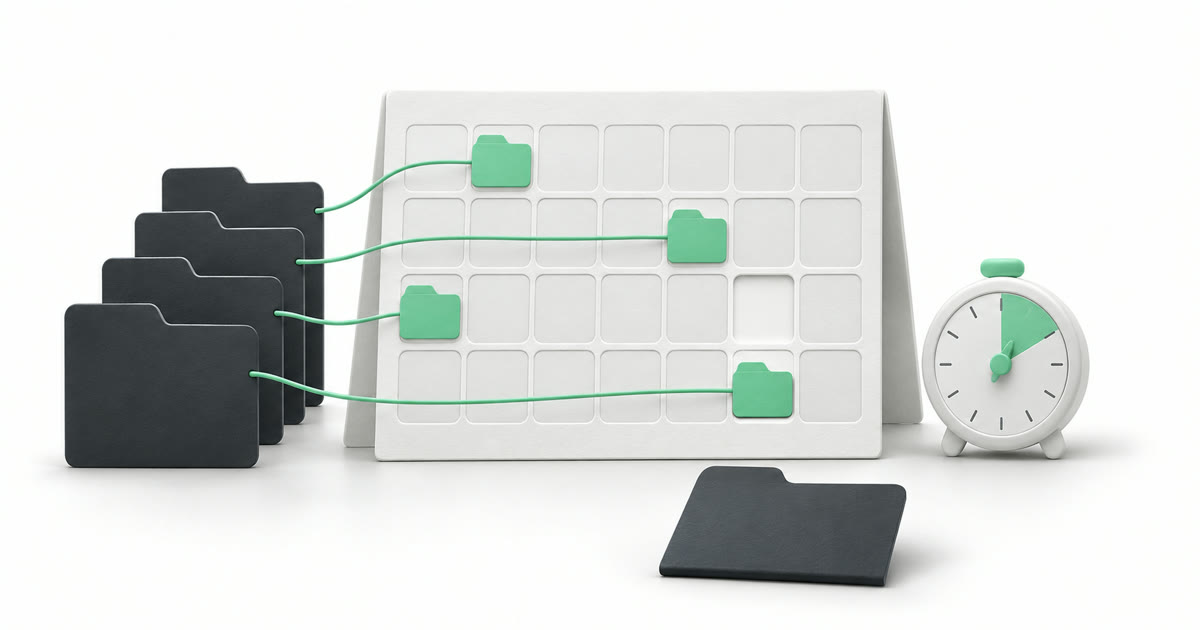
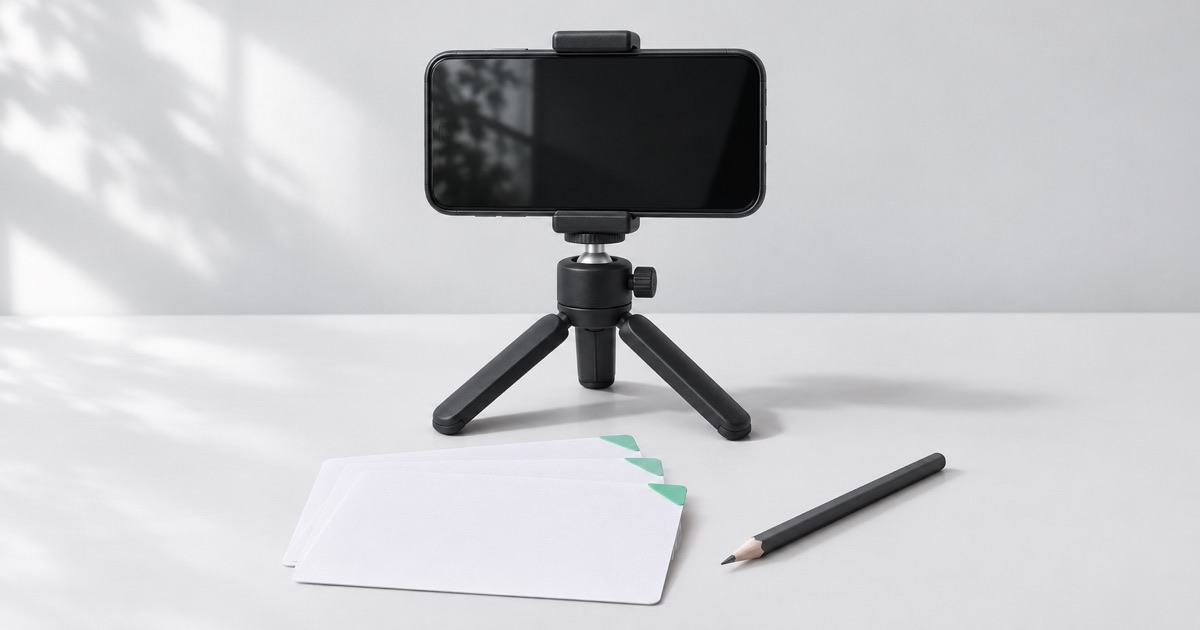
A thought leadership video needs an explanation the viewer can use, an expert who can stand behind it and a recording that preserves both. Start with the question and the example. Choose the title, camera setup and editing treatment after you know what the viewer should understand.
This guide helps the owner of a professional services firm prepare one recording with a member of their team. It includes a filled brief, a sample spoken answer and a six-take editing exercise. The exercise is entirely fictional: no footage was produced or reviewed, and no commercial result is being reported. Its purpose is to make a production decision you can test with your own recording.
Choose a question that benefits from being shown
“Let's make a video about our expertise” leaves the expert and editor with too many choices. A narrower question gives them a shared job. What is the viewer getting wrong? Which example would make the distinction visible? What should the viewer be able to check afterwards?
Consider a consultant explaining why a stalled decision does not always need another meeting. Two situations may look similar in a task list: in one, the options are understood but nobody has authority to decide; in the other, a decision owner exists but lacks an important fact. Showing those two situations side by side gives the camera something to do.
If the answer depends mainly on a long reference table, a written guide may be more usable. If the explanation needs questions from the audience, a webinar may suit it better. A video earns its place when the expert's spoken reasoning and the material on screen help explain the same decision. It does not become useful merely because someone appears on camera.
This is a different task from extracting clips from an existing event. Our webinar repurposing guide starts with material already recorded. Here, you can change the question, simplify the example and record a missing sentence before there is an edit to rescue.
Give the expert a small, specific recording brief
In Oktopost's conversation with Matt Scheetz, Dykema's content manager describes prepared scripts, recording one line at a time and repeating a line when needed. This experience informs our brief; it establishes neither a standard production time nor an effect on sales.
Download the worked expert video brief. It names the viewer, the question, the distinction to demonstrate, the example, the material to show and the review still required. Replace those entries before giving it to a real expert. A company presentation alone would leave most of that work unresolved.
The brief should also say what the video does not cover. In our example, the expert explains how to identify a missing decision condition. She is not teaching every method of governance or diagnosing a particular company's situation. That boundary makes it possible to finish an answer without pretending that the subject is simple in every case.
Send the proposed question and example ahead of the recording. Ask the expert to challenge them: is this a situation they can explain, and is the proposed distinction defensible? If not, change the brief. Our expert interview guide can help collect the explanation first. Recording an expert struggling with an invented argument will not fix the argument.
Work through Nora's fictional explanation
Nora runs a fictional operations consultancy. Émile coordinates the recording and prepares an edit for her review. The intended viewer is a service-business manager deciding what to do when a decision stalls. Every person, document, take and event in this example is invented.
The proposed question is: before adding another meeting, are you missing a decision owner or information? Nora prepares two simple cards. Card A says that the options have been compared but nobody has been appointed to choose. Card B says that the owner is known but the cost of the second option is missing. These are teaching examples, with no client names or real project data.
Her proposed spoken answer is:
A stalled decision does not always need another meeting. First, check what is missing. Here, the options have been compared, but nobody has been appointed to choose. The next action is to identify who can decide. In this second example, that person is known, but the cost of one option is missing. The next action is to obtain that information. If the necessary information and the decision owner are in place, a meeting can have a precise purpose: examining the remaining disagreement. These two checks do not settle every difficult decision. They help you name the next action before adding time to everyone's calendar.
The contrast is the useful part. A title such as “Meetings are useless” would change the meaning and overstate the example. “Before another meeting, check what is missing” describes the actual answer. Neither title nor caption should turn a conditional explanation into a universal rule.
Nora plans to point to each card while describing it. She also says aloud what distinguishes the cards. The explanation should remain understandable to someone who cannot read their small text. Colour alone does not carry the contrast. The same words will help Émile prepare an accurate text version later.
Test the recording before asking for the full answer
Before recording the explanation, make a short test in the place and setup you intend to use. Play it back. Can you understand the voice? Can you read the material being shown? Does the frame preserve the part of the example the speaker points to? Test the result rather than assuming that a recording indicator means the material is usable.
This is a practical check, not a recommendation to buy a particular camera or microphone. If the cards are unreadable, enlarge them or simplify what they show. If speech is obscured, change the recording conditions and try again. An editor needs intelligible source material; an enhancement setting is not a reliable substitute for a missing word.
Let the expert record in complete units of meaning. For Nora, these are the question, the two-case contrast and the conditional conclusion. She can repeat one unit without restarting the whole explanation. When she corrects a sentence, record the complete replacement, not only the word that changed. That gives the editor an identifiable choice.
Keep the raw recordings and a simple note of each take. State whether a take replaces an earlier one and why. Do not ask the editor to infer the intended meaning from several contradictory versions. In the example, P04 replaces P03's unreadable demonstration; P06 replaces P05's incomplete conclusion.
Choose takes by meaning as well as appearance
A Reddit discussion about rejecting software demo videos asks what can be wrong even when an edit looks good. Its author proposes checking what the demonstration actually lets the viewer expect. It is an anonymous prompt about software, not evidence of a production standard. We adapt that question here: what would a viewer misunderstand after this cut?
The six-take worksheet records our simulated answer. Import it as UTF-8 with a comma separator. Its filenames identify fictional takes, not downloadable footage. The decisions are about candidates for an internal edit; they do not authorise public release.
| Take | Decision in the exercise |
|---|---|
| P01 | Reject the opening that says meetings never help |
| P02 | Keep the narrower opening for the internal edit |
| P03 | Replace the demonstration with unreadable cards |
| P04 | Keep the clear demonstration of both situations |
| P05 | Replace the incomplete conditional conclusion |
| P06 | Keep the complete conclusion and its limitation |
Scroll horizontally to read all columns if needed.
The proposed sequence is P02, P04, P06. P02 asks the question, P04 supplies the contrast and P06 states when a meeting can have a defined purpose. P01 is not a punchier alternative: its claim is incompatible with the conclusion. P03 and P05 remain in the record so the reasons for their replacement stay visible.
This exercise has an important limit. Selecting three rows does not prove that three real clips will fit together. Once footage exists, inspect the joins, sound, image, wording and context in the assembled version. A spreadsheet cannot show whether a pause looks unnatural or a correction was cut at the wrong place.
Review the assembled version with and without sound
The expert should review the actual version intended for release, not just the approved script. Read the title, watch the opening and follow the explanation through its last sentence. In Nora's case, both examples and the conditional conclusion must survive. A cut that keeps only “identify who can decide” would erase the situation where information is missing.
Later, Scheetz describes overusing audio enhancement until the voice sounds robotic. Compare processing with the source and check for altered or lost words before accepting it.
Plan the text alternatives as part of production. The W3C guidance on planning accessible audio and video provides a primary reference for considering accessibility early. Prepare captions and a text version that reflect the final edit. Check names, negations and conditional words manually; do not treat an automatic transcript as the reviewed answer.
Watch once with sound off to inspect the captions and the legibility of the cards. Then listen without relying on the cards. These are useful editorial checks, not a complete accessibility audit. If a visual distinction is essential but absent from speech or text, revise the explanation or provide an appropriate alternative rather than claiming that captions alone solve it.
Release one explanation before commissioning a series
Agree who checks the expert meaning, who checks the edit and who gives the release decision. Save the identity of the reviewed version with those decisions. If the wording or sequence changes afterwards, return the changed version to the relevant reviewer. A recording session ending successfully is not a release decision.
For the first use, make the video's question and purpose easy to find wherever it is hosted or linked. Someone sharing it should be able to describe which question it answers. Ask a colleague unfamiliar with the example to explain the distinction back to you. If they think Nora recommends abolishing meetings, the content has failed its own comprehension check, however polished the edit looks.
That check does not predict enquiries or revenue. After release, record the questions viewers actually ask and any attributable uses you can observe. Keep those observations separate from views and from your production notes. Use them to decide what deserves a follow-up explanation rather than assuming that a series needs to be filled.
Kmino's Allbound service works from expertise and recordings supplied by the client; the team handles editing and distribution. You can review the services in French and use this brief to identify the preparation your team can supply. Begin with one explanation you can defend and one release decision you can trace.